Outdoor Activity Ideas
Why Don't You....
-
Explore nature focusing on the senses - what can you see, touch, hear and smell?
-
Learn to read a map
-
Use a compass
-
Follow a local history trail
-
Enjoy a forest / woodland walk
-
Keep a walking journal
-
Use a magnifying glass to look closely at plants, rocks and tree bark
-
Identify patterns in nature
-
Create your own den
-
Observe wildlife from your school grounds or local park or from a beach
-
Learn about the sounds of nature e.g. birdsong and identifying common species
-
Experience animal tracking by way of looking for footprints in soft ground, tufts of fur caught on fences, feathers on the ground or even scratches on tree trunks
-
Identify different tree types as well as how to age a tree
-
Experience pond-dipping and rock-pooling
-
Search for the different types of animal homes from nests to burrows and holes and identify the ideal conditions for the maintenance of their habitats
-
Identify the different types of cloud and how they are formed
-
Investigate the different natural materials hidden away below the surface and research how they are formed e.g. soil, minerals, clay, silt, sand and fungus
-
Make your own mud bricks
-
Learn how to become a geologist by exploring and discovering different types of rock before sorting and classifying into igneous, sedimentary and metamorphic
-
Explore coastal areas to locate fossils
-
Watch the sun set
-
Learn how to pitch a tent
-
Venture out on a bat hunt
-
Experience a night walk by torchlight
-
Experience stargazing and discover why the stars appear to change position, moving across the sky
-
Study the different phases of The Moon
-
Learn how to climb a tree and descend carefully
-
Make your own tree swing
-
Create your own obstacle course using objects from the natural environment
-
Experience geocaching
-
Discover trailblazing (otherwise known as tracking or waymarking)
-
Count your steps and use to create maths problems that you could pose to your friends
-
Make and fly a kite
-
Learn about the water cycle
-
Research a river food chain to discover how living things obtain food and how nutrients and energy are passed on from creature to creature
-
Explore wildlife living on the river e.g. snails, frogs, otters and dragonflies
-
What can you find out about amphibians? What is the life cycle of a frog and what does metamorphosis mean?
-
Learn how to skim stones across a stretch of water
-
Play Poohsticks and learn about the origin of the game
-
Create your own 'Find the Pebbles' hunt - collect pebbles or stones and decorate with different acrylic paint colours before writing letters or numbers on each then cover with a coat of varnish. Then hide the pebbles outside to create an orienteering style game where players have to locate them then try putting them into numerical order or to spell out words
-
On a sunny day, enjoy creating different shaped shadows and photographing them to create an art display
-
Create shadow character puppets and then make up a story for performance to others
-
Play Shadow Tag and / or Shadow Hopping
-
Use the outdoor environment as a location for meditation and / or yoga
-
Explore an orchard to pick apples. You could also find blackberries from hedgerows- what recipe could you follow to enjoy the delicious fruit collected e.g. Baked Apples?


Arty Crafty Ideas
Why Don't You...
-
Collect wildflowers to press that can be later used on greeting cards and book marks. Use PVA glue to affix them onto a jam jar to create a cool pen pot
-
Create a nature bracelet
-
Use natural materials to create a picture on the ground or to create a sculpture
-
Dabble with nature rubbings, leaf prints or use nature's own colours to paint
-
Experiment with photography to create a display of nature pictures.
-
Create your own imaginary magical potion using ingredients from the natural environment
-
Create your own nature creature using modelling clay and natural materials
-
Search for and photograph hidden faces within the natural environment
-
Create your own wind streamer from natural materials before experimenting with patterns through movement and even making up a dance routine
-
Make a twig raft through the collection of long, thick sticks of a similar length with leaves and petals to personalise your design. Trying sailing it in a shallow stretch of water to test for and learn about buoyancy
-
Create music from natural materials e.g., blades of grass or make musical instruments e.g. maracas made from gathering small stones to then contain inside a small plastic bottle or ice-cream tub.
-
Make a twig bird box
-
Create your own terrarium as a home for snails and study how they live
-
Create a bird's nest from twigs, vines, feathers , moss and long grass
-
Create a miniature pond as a great way to encourage frogs, toads and newts into your wildlife area - use a large waterproof container, such as an old sink, sturdy bucket or washing-up bowl before adding gravel/pebbles then rainwater and several pond plants to enable some shade and a hiding place for the small creatures
-
Create a pine-cone bird feeder
-
Construct a bug hotel as a place within a flat, sheltered section of your wildlife area that can be built using bricks or old wooden pallets. Bamboo, straw, corrugated card, pine cones , pebbles and leaves are ideal for bees, ladybirds, beetles, centipedes , spiders, frogs and lacewings ,
-
Experience upcycling to transform empty plastic milk bottles into watering cans that can be decorated to personalise
-
Make your own biodegradable newspaper seedling pots
-
Use old terracotta pots to transform into decorated plant-pot birdbaths
-
Recycle old toys and wellington boots into unique garden planters
-
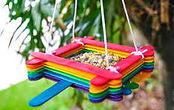
Create your own lollipop stick bird feeder
-
Make a paper-plate sundial
-
Create your own water wall to catch rainwater using old vacuum-cleaner pipes, plastic bottles and sieves attached to a large pegboard to assist with storage
-
Create your own unique footprint stepping stones
-
Experience nature weaving with four sticks for the frame, a small ball of yarn and flowers with stems, blades of grass, twigs and feathers
-
Design your own leaf-print bag
-
Create your own Autumn-leaf bowl with the aid of a balloon, PVA glue and paintbrush, a carrier-bag full of brown leaves and scissors
-
Make twig star decorations for your wildlife area using sturdy twigs, secateurs, scissors, newspaper, glue, old colourful plastic bags, a bowl, sticky-back plastic and string
-
Make your own dreamcatcher from different shades of brightly coloured twine, an embroidery hoop, different coloured beads, feathers and glue
-
Recycle old tin cans to create your own decorated tin-can bowling game
-
Make a twig marble run
-
Make your own wind chimes through the use of such materials as strong, thick twigs (for the frame) , secateurs, strong glue, long lengths of differently coloured embroidery thread as well as old spoons and keys with nuts and bolts also working effectively
You could also make:
-
Feathered headdress
-
Floral crown
-
Wooden peg fairies
-
Musical twig instruments