


KNOWLEDGE OF HEALTH AND FITNESS
Did You Know That:
Your skeleton is the framework that keeps your body supported, and your muscles enable that framework to move. The type of muscles that move bones about are called voluntary muscles. What happens is that one firstly thinks about what movements are to be made. Your brain then works out which muscles are required and sends messages to those muscles that then move, and so do you.
Muscles make up 40% of one's body weight.
There are more than 600 muscles within the human body.
There are three types of muscle:
a) Cardiac - these make up the heart and keep it pumping
b) Smooth - these make up the guts and intestines. They keep the airways to your lungs open. Whilst they squeeze and relax to help food through the intestines, they also react to the pressure in the walls of blood vessels to control the flow of blood.
c) Skeletal - These are affixed to the bones and work with them to move the body
Muscles function in pairs that pull in opposing directions. They therefore never push. Muscles contain a protein called actin. When another protein, myosin, sends a message to the actin, the muscle tightens up (or contracts). So when somebody tries to show off by flexing their arm muscles, it's the biceps muscle on the top of your arm that pulls your lower arm up. When you straighten your arm, the triceps muscle on the other side pulls it back down again.

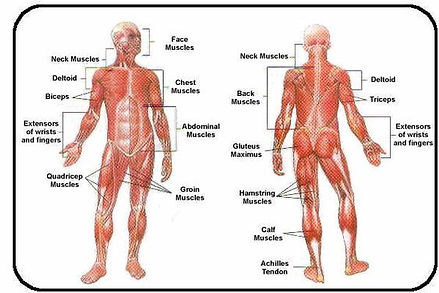

It would not be possible for muscles to move the body around if they weren't joined to the bones. Tendons, that are like cords made of tough tissue, link your muscles to the bones. Cartilage is a flexible tissue that functions as a shock absorber where bones meet at the joints. Joints also have stretchy straps (like tight rubber bands) called ligaments, that connect the bones - they also prevent some joints from moving too freely e.g. if you've ever twisted your ankle then you'll be aware of what it is like to have a joint that moves too much.
What Causes A Stitch When Exercising?
The two likeliest answers are centred around the diaphragm, the large muscle that controls breathing. One theory is that the muscles doing the hard work (exercising) divert blood that would have gone to the diaphragm. The diaphragm then starts to cramp (moving in a sudden and painful way). Alternatively, another explanation is that undigested food below the diaphragm gets sloshed around by the exercise , causing ligaments leading to the diaphragm to become sore.
If a stitch does take place, it will typically ease if one stops or reduce the intensity of the activity. One needs to be careful about what is eaten prior to exercise and, if a stitch does occur then take a short break before continuing exercise.
Recommended reading: https://theconversation.com/health-check-why-do-we-get-a-stitch-and-how-can-we-stop-it-64613
What Causes Cramp?
It is when a muscle goes into spasm and refuses to relax.
The pain in the affected muscle can range from a slight spasm to agonising pain. It can last a few seconds through to 15 minutes and can recur.
There are three major factors:
-
Fatigue: Cramp sets in when our muscles are tired
-
Hydration: We get cramp when we have not drunk enough water
-
Conditioning: The less fit we are, the more likely we are to suffer from cramp
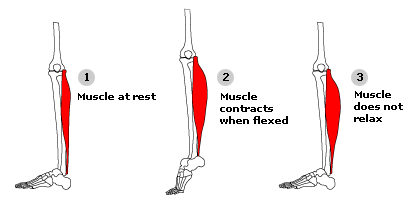
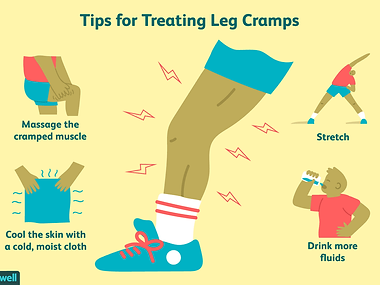
The immediate treatment for muscle cramp is to stretch and gently massage the muscle. Use ice packs for severe cases and drink water or a sports drink.
Grasp the muscle with one hand and pull back on the toes with the other. Point toes upward to help relieve the spasm.
You can continue exercising after massage but if the pain is too acute then 24 hours rest is advised.
Cramp can be avoided through a proper warm-up (especially stretching) that is essential as well as generally good fitness. Absorption of plenty of fluid as well as a nutritious diet are also recommended.